
By: Fernando David Márquez Duarte
fdmdj@hotmail.com
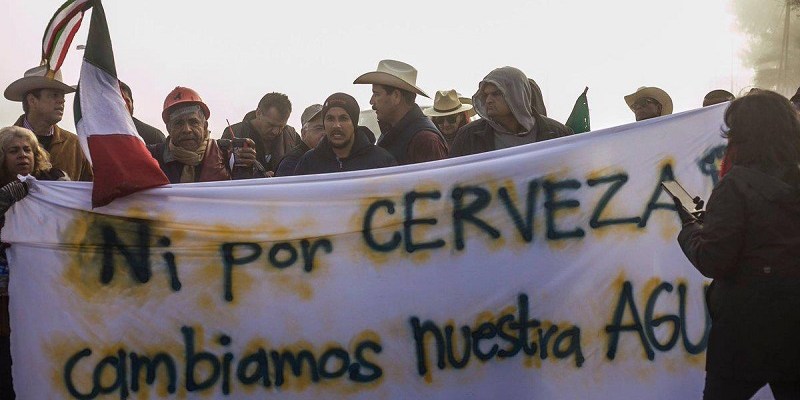
On March 21st and 22nd of 2020 a public consultation took place in Mexicali, where the continuation of the transnational brewery company ‘Constellation Brands; in the area was inquired. In this consultation there were two options you could vote: YES to the brewery or NO to the brewery, where the NO won with an astonishing 76% of the votes (29,793), meaning that the brewery project could not continue anymore in Mexicali. This public consultation was called by the federal government due to the pressure of the social movement in defense of water in Baja California, considering a relevant success of the movement towards achieving emancipation of the oppressed.
Context of the resistance in defense of water and the irregularities of Constellation Brands
To understand the issue, I share a brief contextualization: The interest of Constellation Brands about establishing in Mexicali began in 2015, by means of the Economic Incentives Group report (Cervantes, 2017). In this same report it was specified that the company required 20 million cubic meters per year for at least 50 years (Niño & García, 2019, p. 181). Since 2015 CONAGUA expressed their concerns for the over-allocated water resources of the Mexicali valley, which risked the availability of water for all the region (Meluso, 2019). It is important to stress that the water of Mexicali is used to supply a broader region, including the cities of Tijuana, Tecate, Ensenada and San Luis Río Colorado (Comisión Nacional de Derechos Humanos, 2020, para. 48).

The beginning of the conflict between the transnational brewery and the citizens of Mexicali began in early 2017, with a series of massive protests in Mexicali which led to the organizing of social movements (Márquez Duarte, 2018). The protests that took place in Mexicali demanded the revocation of the new state water law that allowed the government to privatize an important amount of water of the state to sell it, mostly to Constellation Brands. For five consecutive Sundays between January and February dozens of thousands of people took part in the protests. In one of these five protests (on January 15th) more than 50,000 people in Mexicali protested and marched to the city hall, situation that never happened before in the city (Márquez, 2017). After these protests in Mexicali, the governor of Baja California (who was ‘Kiko’ Vega from the right-wing party PAN in that time) withdrew the state water law, however the negotiations with the Constellation Brands continued (Márquez, 2017).
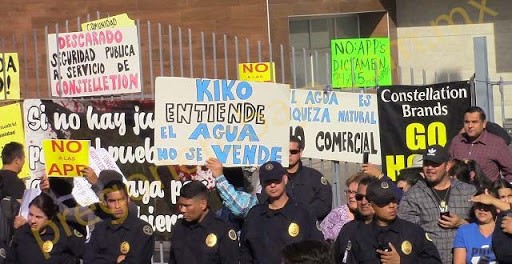
Since early 2017 the transnational company began the establishment process in Mexicali. During this process several issues have been denounced, which can be categorized in three: water availability problems, corruption perception of the project and repression and blocking of protests (Márquez Duarte, 2020). Both the previous local government and Constellation Brands have been involved in the three categories of issues.
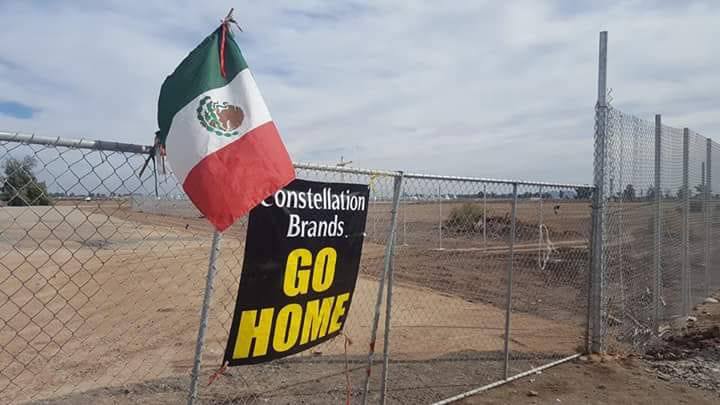
As a transnational brewery, Constellation Brands requires an immense amount of water, as well as an important amount of land to operate. According to Dr. Alfonso Cortez, researcher in water issues in the region, it is estimated (with a modest prediction, which means that the percentage could be higher) that the brewery would also use 35.5% of the water reserve of Mexicali, as well as 792 irrigation hectares, adding to these the underground water usage, the equivalence of irrigation hectares would increase to 1,484 and the use of the water reserve would increase to 44.1% (Cortez Lara, 2019). This information shows that the numbers of water usage stated by the brewery in media and in government processes was inaccurate, which according to the company would be less than 0.5% of the total water available (Monroy, 2020).
Regarding corruption perception there are various journalistic sources that show evidence of the legal and ethical irregularities of the project of Constellation Brands, as well as the potential involvement of the state government. Moreover the National Commission of Human Rights (CNDH), concluded that the previous state and federal government violated the right to water for the people in the region, and that both levels of government had legal responsibility in the issue (Cervantes, 2017; Comisión Nacional de Derechos Humanos, 2020, paras. 41, 331; Corpus, 2019).
The repression and blocking of the participation of citizens organized in social movements has constituted an important influence of the conflict, because it has fed the discontent of the social movements’ participants and of the people of Mexicali in general. One example of repression happened on January 2018, which was documented with video, pictures and testimonies. These proofs were useful to the CNDH to declare that both the state government and Constellation Brands violated the law. The police forces used force to repress the protesters, causing serious injuries in several of them (Comisión Nacional de Derechos Humanos, 2020, para. 23.3). As mentioned before, the state government not only used force to impose repression on the protesters, but also accused some of them of various crimes (Villamil, 2018).
Critical decolonial approach
On the other hand, to discuss about critical decolonial resistance, it is important to have a brief discussion about the Latin America context, which it is ingrained, specifically from the inequality and oppression that are a part of the region, (which from now on I will refer to as Abya Yala, which is the indigenous conception that surged from the Kuna/Puna people in Central America to refer to the region (Del Valle, 2015)) which have caused and increased the millions of people living in precarious conditions and concentrated wealth into fewer and fewer elites (Galeano, 2004; Monsiváis, 1981; Sánchez Vásquez, 1996).
In line with the previous arguments, González Casanova’s (2006) concept of internal colonialism is relevant, he argues that the elites have perpetuated this system that has increased the amount of poverty, oppression and marginalization, and concentrating wealth into fewer hands; it is important to highlight that his system is not only imposed economically but also culturally, where the elites determine what is acceptable and what is not. This oppression and control use propaganda and mass media to make people interiorize it. In this system, the elites in colonized countries act as an intermediary of the western elites; they only seek to serve the perpetuation of capitalism that is manifested currently as neocolonialism. The colonized elites openly serve the big transnational companies by selling concessions, commonly by corrupt acts (Fanon, 1963, pp. 76, 86).
To discuss the case of the resistance in defense of water of Baja California, Dussel (1973, p. 56,57) argues an important point; he claims that a dialectic comprehension is needed to understand reality, which according to him it is about the understanding that passes through ‘the other’; he furthermore argues that there cannot be an absolute universal understanding of the world or a speculative intuition model that can be used to abstractly analyze situations with a formula. Dussel’s idea regarding the dialectic comprehension is important to this analysis, since even if the emancipation of the oppressed is a process that surges from the oppressed, it is important that everyone develops critical consciousness not just the oppressed, which is a dialectic exercise to understand ‘the other’, so the groups that are not directly oppressed by the issue realize that the issue needs to be addressed and find alternative ways to live and exist to reach emancipation.
I argue that the resistance in defense of water as a human right and against Constellation Brands is a case of critical decolonial resistance. My theoretical approach consists of three main points with a goal: the development of critical consciousness, rethinking the role of academia and science in producing and socializing saberes and the crucial role of praxis with the oppressed having as final goal to support the development of emancipation against colonial and capitalist oppression. In order to achieve emancipation, it is necessary to develop critical consciousness not only in the oppressed but in the people in general; one way to develop critical consciousness is with the stages of exhibiting, proposing and politicizing the issue at hand. It is important to emphasize that the individuals and groups are the ones that develop critical consciousness by themselves, the role of the educator/academic/scientific is only as facilitator of this process; it is not about imposing her/his vision of critical consciousness and/or emancipation on the oppressed. The role of the researcher then is to socialize the voice of the oppressed, without imposing or appropriating their saberes; is going to the field and visualize the struggles, demands and saberes of the oppressed by praxis, in order to support them in their struggles towards emancipation against oppression and at the same time fostering critical consciousness in the population in general so they realize the issue that the oppressed groups are trying to change and support this change even if they are not directly oppressed by the issue at hand.
It is worth noting that environment is a crucial element of this approach from Abya Yala, because an important element of colonial oppression is the colonization of nature and life, which seeks to destroy the ancient relation between human, spiritual and natural worlds, which sustains integral life systems and humanity as a whole (Walsh, 2008, p. 138). Moreover, environmental issues are social processes that are caused by the inequality and power relations in specific contexts, which regarding environment destruction are engrained in the over-consumption and waste of the Global North and in the inequality and poverty of the Global South (Calixto Flores, 2010).
Conclusion
This resistance movement has achieved success with the public consultation triumph and thus, the rejection of Constellation Brands in Baja California. However, the local congress recently approved a new water law for Baja California which allowed the state government to concentrate the power and decisions about water in the state without transparence, creating a government office for water. This law allows the government to make unilateral decisions regarding the use and selling of the water of Baja California, which is already causing negative effects in the water of Baja California; the state government is negotiating with Constellation Brands to move the production plant from Mexicali to other city in Baja California (Nieblas, 2020), which will cause the same problem because all the aquifers of the state are in critical conditions of overallocation of water and cities like Ensenada and Tijuana commonly suffer from water shortage.
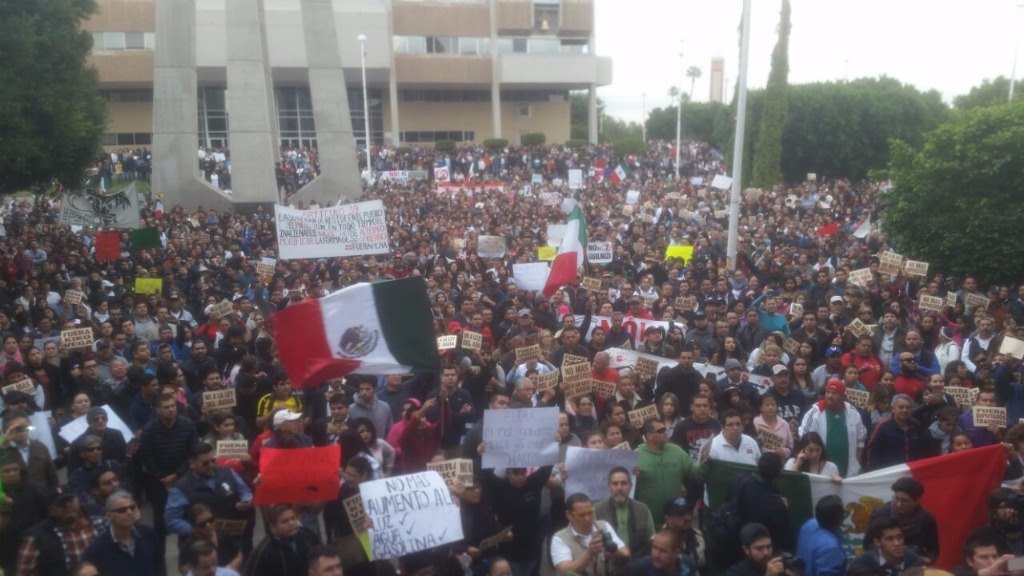
It is crucial to raise awareness of the water issue in Baja California, because it affects not only the people of the state but water availability for the people in the whole region, water is not only an invaluable resource but is what allows humanity to survive, and as such it should be protected as the most important subsistence element for life.
References
Calixto Flores, R. (2010). Educación popular ambiental. Trayectorias, 12(30), 24–39.
Cervantes, J. (2017, August 11). La batalla por el agua: Constellations Brands contra Mexicali Resiste. Proceso. https://www.proceso.com.mx/498510/la-batalla-agua-constellations-brands-contra-mexicali-resiste
Comisión Nacional de Derechos Humanos. (2020). RECOMENDACIÓN NO. 1 /2020 SOBRE LAS VIOLACIONES AL DERECHO HUMANO AL AGUA EN PERJUICIO DE LA POBLACIÓN EN GENERAL Y AGRICULTORES DEL VALLE DE MEXICALI, DERIVADAS DE ACTOS Y OMISIONES EN DIVERSOS TRAMITES Y PROCEDIMIENTOS PARA LA INSTALACIÓN Y OPERACIÓN DE UN PROYECTO INDUSTRIAL DE CERVEZA, EN EL MUNICIPIO DE MEXICALI. (Recomendación No. 1/2020). Comisión Nacional de los Derechos Humanos. https://www.cndh.org.mx/sites/default/files/documentos/2020-02/REC_2020_001.pdf
Corpus, A. (2019, February 19). Alertan por agua en Mexicali con cervecera. Mural. https://www.mural.com/aplicaciones/articulo/default.aspx?id=1613390
Cortez Lara, A. (2019). Opinión Técnica sobre la Manifestación de Impacto Ambiental (MIA) del Proyecto de Construcción y Operación de la Planta Cervecera Constellation Brands en Mexicali, Baja California. [Estudio elaborado para CONACYT]. COLEF. https://drive.google.com/file/d/1aVaQguNt_N5_cuok8djJ1XLSjEy5uBDm/view?usp=sharing&fbclid=IwAR3Zpoe1wM2xSbQbpHQEEKwSJ-2XWZq1f7iNzX7gDR8x0fkndk1OjgKTVdk&usp=embed_facebook
Del Valle, E. (2015). Self-Determination: A Perspective from Abya Yala. In M. Woons (Ed.), Restoring indigenous self determination (2nd ed., pp. 101–109). E-International Relations.
Dussel, E. (1973). Para una ética de la liberación latinoamericana. Siglo XXI,.
Fanon, F. (1963). Los condenados de la tierra (1st ed.). Fondo de Cultura Económica México.
Galeano, E. (2004). Las venas abiertas de América Latina. Siglo xxi.
González Casanova, P. (2006). Colonialismo interno (una redefinición). In La teoría marxista hoy. Problemas y perspectivas (pp. 409–434). CLACSO.
Márquez Duarte, F. D. (2018). Participación ciudadana juvenil en Baja California, México y California, Estados Unidos: El caso de los Modelos de Naciones Unidas. [M.A.]. El Colegio de la Frontera Norte.
Márquez Duarte, F. D. (2020, January 26). ¿Por qué la resistencia a la Constellation Brands? Medium. https://medium.com/@fernandodavidmrquezduarte/por-qu%C3%A9-la-resistencia-a-la-constellation-brands-572bc82db512
Márquez, F. D. (2017, January 23). The power of citizen participation [International issues site]. Modern Diplomacy. http://moderndiplomacy.eu/index.php?option=com_k2&view=item&id=2171%3Athe-power-of-citizen-participation&Itemid=138
Meluso, A. (2019). La gota que colma la caguama: Cummulative Tensions Transformed into the Defense of Water [University of New Mexico]. https://digitalrepository.unm.edu/geog_etds/44
Monroy, J. (2020, January 18). Constellation Brands busca garantizar abasto de agua en Mexicali ante protestas. El Economista. https://www.eleconomista.com.mx/estados/Constellation-Brands-busca-garantizar-abasto-de-agua-en-Mexicali-ante-protestas-20200118-0011.html
Monsiváis, C. (1981). Notas sobre el Estado, la cultura nacional y las culturas populares en México. Cuadernos Políticos, 30, 33–52.
Nieblas, A. (2020, July 20). “No hay condiciones para analizar permanencia de cervecera”: SEPROA. RADAR BC. http://www.radarbc.com/index.php?mod=1&op=2&ver=14745&fil=8&fbclid=IwAR2IDNJHh2bbge8LEBLmTKlqzd4EIlHIDHzrzOva_JjUPbRF-WHX8Z6k2Ws
Niño, L. M., & García, N. (2019). Participación ciudadana, actor social emergente: El movimiento por la defensa del agua en Mexicali. Vinculos. Sociología, análisis y opinión, 0(14), Article 14. http://www.vinculossociologiaanalisisyopinion.cucsh.udg.mx/index.php/VSAO/article/view/7489
Sánchez Vásquez, A. (1996). La utopía del fin de la utopía. In Marx Ahora (pp. 105–119).
Villamil, J. (2018, May 23). Tras 20 días en la cárcel, juez libera a León Fierro, dirigente de Mexicali Resiste. Proceso. https://www.proceso.com.mx/535593/tras-20-dias-en-la-carcel-juez-libera-a-leon-fierro-dirigente-de-mexicali-resiste
Walsh, C. (2008). Interculturalidad, plurinacionalidad y decolonialidad: Las insurgencias político-epistémicas de refundar el Estado. Tabula Rasa, 9, 131–152.
 Chaanpal News